








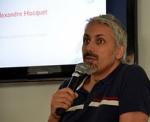
Alexandre HOCQUET
- Professeur - Université de Lorraine
- https://orcid.org/0000-0001-6361-5780
A pdf author version of any paper listed here is available upon request.
In Aachen as a RWTH KHK c:o/re fellow from October to March 2022, from November to December 2022, from June to July 2023.
In Philadelphia, PA as a Science History Institute fellow from March to August 2019.
2026
- Wieber, F., & Hocquet, A. (2026). A Portrait of the Scientist as a User: Openness and Temporality of Scientific Software. Social Epistemology, 1–14, special issue on "Openness and Inequity in Scientific Research" Edited by Paola Castano, Rena Alcalay and Sabina Leonelli, with a postface by Helen Longino, June 2026, Preprint available at PhilSci Archive
- "And the winner is... AlphaFold!", Marcus Carrier, Alexandre Hocquet and Frédéric Wieber, talk at the Future of Open Research Conference, Munich, May 2026, video available
- "A portrait of the scientist as a user", History of Science Department Colloquium, TU Berlin, February 2026
- Grant "Reproducibilty has politics" from the VolksWagen Foundation with Johannes Lenhard, RPTU.
2025
- "A portrait of the scientist as a user", keynote lecture at HAPOC 2025 in Aachen, December 2025
- "Et le gagnant est... Alphafold !", conférence introductive à la 10e Journée Nationale d'Etude de l'URFIST "Intelligence Artificielle Générative et Production des Connaissances Scientifiques", Aubervilliers, 25 Novembre 2025 (video)
- "Code Histories", triple panel at SHOT 20025 in Luxembourg, co-chaired with Titaÿna Kauffmann, Mathilde Fichen and Frédéric Wieber, Octobre 2025
- "Science ouverte entre militantisme et outil du capitalisme", Interview par Hugo Ruher pour Sciences Critiques, Octobre 2025
- "A portrait of the Computational Scientist as a User", talk at the "Layers of Reproducibility" panel, EPSA 2025, Groningen 30 August 2025
- "Juggling Molecules in Vector and Raster Graphics", talk at the "Computer in Motion" panel, 27th ICHST 5th July 2025, Dunedin.
- "Juggling Molecules : Toward an Archeology of Computational Tools in Chemistry", P. H. Roth, F. Wieber, A. Hocquet, A. Olteanu Cybernetics and Human Knowing, 31(4), 129-144, March 2025
- "And the winner is... Alphafold!", F. Wieber, A. Hocquet, M. Carrier, Backchannels, 3rd February 2025
- "Elon Musk met une cible dans le dos de Wikipédia" interview par Quentin Meunier pour 20 minutes, 23 Janvier 2025
2024
- "Whither Software ?", Software group meeting, Aachen, 3rd December 2024
- "Quand Google déboule chez les Nobel" interview par Lucile Veissier pour The Metanews, 15 Novembre 2024
- "Computational chemistry and tensions around software in computational science", F. Wieber, A. Hocquet, ESHS Conference, Barcelona, 5 September 2024
- "Software in Science" research group meeting, A. Hocquet, Aachen, 24 July 2024
- "When digital was computational : circulation of scientific software" A.Hocquet, F. Wieber 4S/EASST conference, Amsterdam, 19 July 2024
- "Reproducibility, Photoshop, and Collective Disciplining" F. Wieber, N. Callaerts and A. Hocquet, 4S/EASST conference, Amsterdam, 16 July 2024
- "Software is Ubiquitous, Yet it"s Overlooked" A. Hocquet et al. Nature Computational Science, July 2024.
- "Rolling out the Software Millefeuille", workshop organized by J. Lenhard, Kaiserslautern, June, 20th, 2024
- “Reproducibility, Photoshop, Pubpeer, and Collective Disciplining” A. Hocquet, N. Callaerts, F. Wieber talk, Aachen, May 17th, 2024
- "Juggling Molecules" A.Hocquet, P.Roth, A. Olteanu, F, Wieber, talk at the "Writing the history of computer visualizations" workshop, Paris, May 2nd, 2024
- Alexandre Hocquet. Ouvrir la science - mais à quoi ?. Alliage : Culture - Science - Technique, 2024, 83.
2023
- "Conducted Properly, Published Incorrectly”, N. Callaerts, F. Wieber and A. Hocquet, "Explaining Misconduct" Conference, NAncy, 7th december 2023.
- "The subtle impact of software on trust", SAS23 Conference, Reliability & Trustworthiness, Stuttgart, 30th November 2023.
- "Reproductibilité, Photoshop, et disciplinarisation collective", N. Callaerts, F. Wieber et A. Hocquet, dans la "lettre de l'INSHS", novembre 2023.
- "Wikipédia comme projet pédagogique", Wikicafé du réseau URFIST, 17 octobre 2023
- "L'embellissement en science est banal", Interview par Lucile Veissier sur The Metanews, 13 octobre 2023
- "Mailing lists as a means of communication between scientists. A new kind of corpus for historians of science", in "Modalités de la communication scientifique et technique / Communicating Science and Technology", Peter Lang, 2023
- "The many faces of reproducibility : Photoshop and Collective Disciplinning", intervention au colloque "reproductibilité et réplicabilité" CNRS, Paris, 8 Septembre 2023
- Callaerts, N. Hocquet, A. Wieber, F. "Conducted properly, published incorrectly" :
- "From transparent to invisible : Sofware as the elephant in the room", at Whither Open Science? PHIL_OS Exploratory Conference, Exeter, March 31st
- "The many faces of reproducibility", intervention aux journées de la reproductibilité, Institut Pasteur, Paris, 8 mars.
- "Only the Initiates will have the Secrets Revealed", A. Hocquet intervention à la graduate school "Complexity and Transdisciplinarity", IMERA Marseille, 28 février.
- “For 20 years, I haven’t used a pen” – a computer nerd’s confession, A.Hocquet and S. Haupt, February, 3rd
2022
- "scientific software studies" workshop in Aachen, November, 8th-9th
- "Only the initiates will have the secrets revealed" at the "Studies on Open Science" project meeting, Exeter (online), November, 3rd
- "Computational reproducibility and scientific software: beyond code transparency" A. Hocquet and F. Wieber : Society for the Philosophy of Science in Practice Conference, Ghent, 2nd of July
- "The Entanglement of Models and Software. Tools and Representations in Computational Chemistry" P. Roth, A. Olteanu, A. Hocquet and F. Wieber, 4th Conference of the International Association for Cognitive Semiotics, Aachen 15th of June
- Invited talk, "The past, present and future of reproducible computational research practices" A. Hocquet, F. Wieber, K. Hinsen 23 mars à Juelich et le 24 mars à Aachen
- Steal this blog post ! A. Hocquet, S. Haupt, A. Olteanu
- "Science ouverte, logiciels libres", émission "Libre à vous", Radio Cause Commune, 1er février 2022
- "Only the initiates will have the secrets revealed: The politics and materialities of Open Science in a world of Software", KHK c:o/re lecture, Aachen, Janauary 26th, 2022
- "Parameters and Computer Simulations", A workshop with A. Hocquet, F. Wieber, J. Lenhard and G. Gramelsberger, Aachen, January 12th and 13th, 2022
2021
- Callaerts, N. Hocquet, A. Wieber, F. "Conducted properly, published incorrectly" : Circulation of Images in the Life Sciences CHSTM workhop, October 16th, 2021
- Bienvenue sur Wikipédia, le cours STS que vous pouvez améliorer. in Wikipédia, objet de médiation et transmission des savoirs, Barbe et Severo Eds, Presses Universitaires de Nanterre, Septembre 2021
- Frédéric Wieber, Alexandre Hocquet – À la recherche de flame wars dans une liste de diffusion académique in Les Corpus en sciences humaines et sociales, Benzitoun et Rebuschi Eds, Presses Universiataires de Nancy, Avril 2021
- Hocquet, A., Wieber, F. Epistemic issues in computational reproducibility: software as the elephant in the room. Euro Jnl Phil Sci 11, 38 (2021)
2020
- "Is Open scholarship even possible with Zoom?", in The Conversation, 7 December 2020
- "Science ouverte, visioconférence propriétaire", dans The Conversation, 25 OCtobre 2020
- Wieber F. & Hocquet A. (2020), Models, Parameterization, and Software: Epistemic Opacity in Computational Chemistry Perspectives on Science September-October 2020, Vol. 28, No. 5, pp. 610–629
- "Six phrases choc accrocheuses sur la science ouverte, la sixième va vous étonner", intervention à l'Atelier "Science Ouverte & Société" du Centre Internet et Société, 24 Septembre 2020
- "Le temps a changé", interview dans Factuel hors série "Crise sanitaire, qu'avaons nous appris?", été 2020
- Computational Chemistry faces a coding crisis, an interview within a paper by Jamie Durrani in Chemistry World, 1st July 2020
- La science face à l'urgence, Conférence en ligne de l'Agence Universitaire de la Francophonie, 25 mai 2020
- Hocquet, A. (2020). Open Science in Times of Coronavirus: Introducing the Concept of Real-Time Publication. Substantia, 4(1), 937.
- Science ouverte au temps du coronavirus : la publication en temps réel, dans The Conversation, 4 Mai 2020
- La reproductibilité, en crise ?, Vidéo (sous licence CC-BY) réalisée dans le cadre du MOOC Recherche Reproductible, 20 Mars 2020
- Reproduire un résultat scientifique : plus facile à dire qu'à faire, dans The Conversation, 1er mars 2020
- Wieber F. & Hocquet A. (2020). Méthodes de modélisation en chimie computationnelle : pluralisme et pragmatisme, software et benchmarking, pp. 170-176 in B. Bensaude-Vincent & R.-E. Eastes (Eds.), Philosophie de la Chimie, Paris: De Boeck Supérieur.
2019
- Hocquet, A. (2019). Reprenez ce texte sur la science ouverte et transformez-le. In M. Leroy-Terquem & S. Clément (Eds.), S.I.Lex, le blog revisité: Parcours de lectures dans le carnet d’un juriste et bibliothécaire (pp. 527–534). Presses de l’enssib.
- Cette encylopédie gagne à être connue avant d'être jugée, Interview dans l'Est Républicain, 22 Novembre 2019
- Science History Institute twitter takeover for #FellowFriday, 30th August 2019
- En quoi consiste le travail d'une Wikipédienne en Résidence, dans The Conversation, 23 Juillet 2019
- recension de "Le travail invisible des données", Jérôme Denis, dans Communication, Juillet 2019
- Interview par Emmanuel Lemieux à propos de Wikipédia, dans Les Influences, 11 juillet 2019
- On the job with a Wikipedian in Residence, in The Conversation, 10th july 2019
- Bienvenue sur Wikipédia, le cours STS que VOUS pouvez améliorer, conférence à la journée "Wikipédia en tant qu'objet de médiation et de transmission des savoirs" de l'ANR Collabora, 18 Juin 2019. Transcription . Diapos . Vidéo .
- Wieber, F. & Hocquet, A. “Only the Initiates Will Have the Secrets Revealed”: Software Packages in Computational Chemistry, Lunchtime lecture at the Science History Institute, 21st May 2019
- Qui veut la peau de Sci-hub ?, dans The Conversation, 3 avril 2019
- No, Wikipedia didn’t get Oscar-winning actress Olivia Colman’s birthdate wrong, in The Conversation, 14th february 2019
- Non, l’actrice Olivia Colman n’a pas été vieillie de huit ans par Wikipédia, dans The Conversation, 6 février 2019
2018
- Wieber, F., Pisanty, A., & Hocquet, A. (2018). “We were here before the Web and hype…”: a brief history of and tribute to the Computational Chemistry List. Journal of Cheminformatics, 10(1), 67.
- De quoi l'Open Science est elle le nom ?, dans The Conversation, 5 décembre 2018
- Open Source : liberté, égalité ?, Invité de l'émission "la méthode scientifique" sur France Culture, 7 novembre 2018.
- Recension de Qu'est ce qu'un forum Internet ? (Camille Paloque Bergès) dans le Mouvement Social, Novembre 2018.
- Wikipédia, chacun sait ce qu'il lui plaît, le 19 Septembre 2018 sur France Culture, dans l'émission "La Méthode Scientifique".
- Dans la bibliothèque des chercheurs ; "des footballeurs au travail", dans The Conversation, 6 septembre 2018.
- De quoi l'arbitrage vidéo est il le nom?, dans The Conversation, repris dans Slate, 2 juillet 2018. Interview dans l'Est Républicain, 10 juillet 2018.
- Montée à la Pyrrhus, dans Les cahiers du football, 13 Juin 2018.
- Trop fortes pour être femmes, dans The Conversation, repris dans Sud-Ouest et Science & Vie, 14 Mai 2018.
- Hocquet, A., & Wieber, F. Mailing list archives as useful primary sources for historians: looking for flame wars Internet Histories, 2018(1), Avril 2018.
- Les aventures de Velasca au pays des équipementiers, dans Les cahiers du football, 15 février 2018.
2017
- Hocquet, A., & Wieber, F.. « Only the Initiates Will Have the Secrets Revealed »: Computational Chemists and the Openness of Scientific Software. IEEE Annals of the History of Computing, 39(4), Octobre-Décembre 2017.
- Comment les jeux vidéo de football influencent la réalité – et inversement, 16 Novembre 2017 sur The Conversation, Slate, Les cahiers du football, Mashable, france-info et Vice.
- Looking for flame wars, #dhnord2017, Lille, 28 Novembre 2017, vidéo
- Podcast sur The Conversation : Trois questions sur le « libre accès » aux contenus numériques 1 Novembre 2017
- Only the initiates will have the secrets revealed, October 29th, 2017, SIGCIS, Philadelphia.
- Time out of Joint, October 27th, 2017, SHOT, Philadelphia.
- WikiMOOC, 11 Août 2017, Wikimania, Montréal vidéo
- Play the game, Know the Game... Shape the game, August 30th, 2017, 4S Annual meeting, Boston text slides
- Enseigner Wikipédia par les anecdotes, une vidéo sur The Conversation France, le 14 Mars 2017.
- L'article d'Alain Marleix revisité, une vidéo sur The Conversation France, le 23 Mars 2017.
- Le selfie du macaque, une vidéo sur The Conversation France, le 30 Mars 2017.
- Je suis Philip Roth, une vidéo sur The Conversation France, le 17 Avril 2017.
- séminaire du Centre François Viète, 28 février 2017, Nantes audio slides
2016
- Ce que racontent les Football Leaks...dans The Conversation France, Les cahiers du football et Le Point, 12 décembre 2016
- Pour une critique pertinente de Wikipédia, sur The Conversation France, et sur Rue89, le 30 Novembre 2016
- Play the Game, Know the Game, Shape the Game, Essay sur First Person Scholar, 16 Novembre 2016.
- Le Plaidoyer pour enseigner Wikipédia à l'heure du WikiMOOC, sur The Conversation France, le 28 Octobre 2016, et sur Rue89, le 3 janvier 2017.
- Plaidoyer pour enseigner Wikipédia, sur La boîte à outils des historiens, 14 Juin 2016 et sur le blog de Wikimédia france
- Fussball ist wie Schach, nur ohne Würfel ou Big data et Football, dans The Conversation, Les cahiers du football, et Rue89, 10 Juin 2016
- Hocquet, A. (2016). Football Manager: Mutual Shaping between Game, Sport, and Community. Kinephanos, 6 (Special Issue) et en postprint dans SocArXiv
- Qu'est ce que Wikipédia?, 22 Mars 2016 à L'Université Populaire Participative de Vandoeuvre, disponible en audio
- Interview à RCF sur la conférence "Qu'est ce que Wikipédia?".
Domaines de recherche
Even though I am a Professeur des Universités in History of Science, I have been trained as a chemist and the first twenty years of my academic career have been spent doing molecular modelling as a computational chemist. During that time, I experienced the difficulties that arise from using scientific models packaged into a piece of software, from reproducibility to openness issues. After my PhD in 1994, I was a secondary school teacher and computational science was the only way for me do research without being physically present at the bench. The computer and the Internet were increasingly becoming affordable, and I realised I could launch calculations at supercomputing centres from home. I was, in a way, a lay user trying to break my way into academic recognition without an academic position, in a world where "only the initiates would have the secrets revealed".
I defended my Habilitation à Diriger les Recherches in 2002 and was awarded a professorship in 2003, thanks to a CNRS fellowship. From that time on, I gradually became more interested in HPS and STS, taking classes at the Centre Alexandre Koyré. 2013 marked a turning point: It was the year of my first history of science publication and also my last chemistry publication. In the mid 2010s, together with Frédéric Wieber, I started a research programme on software in computational chemistry. I have since built a career as a historian of computational science, supported through a series of fellowships in Philadelphia and Aachen.
I focus on the conditions of production of computational science. My research examines the relationship between the computational scientist and the computer, particularly how the growing importance of software has altered scientific practices. My work focuses on modelling and software— Software Studies— and from a methodological perspective, I innovatively employ a form of historical online ethnography, specifically on corpora of online conversations. Next to my academic work, I actively engage in public outreach of open science and computational science. I do so through my own writing, but also through participation in public conversations and media appearances.
Publications
"A Portrait of the Scientist as a User : Openness and Temporality of Scientiifc Software", Wieber, F., & Hocquet, A. (2026). Social Epistemology, 1–14., special issue on "Openness and Inequity in Scientific Research" Edited by Paola Castano, Rena Alcalay and Sabina Leonelli, Aprll 2026, Preprint available at PhilSci Archive
"Juggling Molecules : Toward an Archeology of Computational Tools in Chemistry", P. H. Roth, F. Wieber, A. Hocquet, A. Olteanu Cybernetics and Human Knowing, 31(4), 129-144, March 2025
A. Hocquet et al. "Software is Ubiquitous, Yet it"s Overlooked" Nature Computational Science, July 2024.
Alexandre Hocquet. Ouvrir la science - mais à quoi ?. Alliage : Culture - Science - Technique, 2024, 83.
A. Hocquet "Mailing lists as a means of communication between scientists. A new kind of corpus for historians of science", in "Modalités de la communication scientifique et technique / Communicating Science and Technology", Peter Lang, 2023
Callaerts, N. Hocquet, A. Wieber, F. "Conducted properly, published incorrectly" :
Hocquet, A., Wieber, F. Epistemic issues in computational reproducibility: software as the elephant in the room. Euro Jnl Phil Sci 11, 38 (2021)
Bienvenue sur Wikipédia, le cours STS que vous pouvez améliorer. in Wikipédia, objet de médiation et transmission des savoirs, Barbe et Severo Eds, Presses Universitaires de Nanterre, Septembre 2021
Frédéric Wieber, Alexandre Hocquet – À la recherche de flame wars dans une liste de diffusion académique in Les Corpus en sciences humaines et sociales, Benzitoun et Rebuschi Eds, Presses Universiataires de Nancy, Avril 2021
Wieber F. & Hocquet A. (2020), Models, Parameterization, and Software: Epistemic Opacity in Computational Chemistry Perspectives on Science September-October 2020, Vol. 28, No. 5, pp. 610–629
Wieber F. & Hocquet A. (2020). Méthodes de modélisation en chimie computationnelle : pluralisme et pragmatisme, software et benchmarking, pp. 170-176 in B. Bensaude-Vincent & R.-E. Eastes (Eds.), Philosophie de la Chimie, Paris: De Boeck Supérieur.
Hocquet, A. (2019). Reprenez ce texte sur la science ouverte et transformez-le. In M. Leroy-Terquem & S. Clément (Eds.), S.I.Lex, le blog revisité: Parcours de lectures dans le carnet d’un juriste et bibliothécaire (pp. 527–534). Presses de l’enssib.
Wieber, F., Pisanty, A., & Hocquet, A. “We were here before the Web and hype…”: a brief history of and tribute to the Computational Chemistry List. Journal of Cheminformatics, 10(1), 67. Décembre 2018.
Hocquet, A., & Wieber, F. Mailing list archives as useful primary sources for historians: looking for flame wars Internet Histories, 2018(1), Avril 2018.
Hocquet, A., & Wieber, F.. « Only the Initiates Will Have the Secrets Revealed »: Computational Chemists and the Openness of Scientific Software. IEEE Annals of the History of Computing, 39(4), Octobre-Décembre 2017.
Football Manager: Mutual Shaping between Game, Sport, and Community. Kinephanos, 6 (Special Issue), Avril 2016
Wikipédia en tant que forum : une analyse de réseaux sociaux pour l’ethnographie de la production d’articles, in Wikipédia objet scientifique non identifié, Presses Universitaires de Paris Ouest, Mars 2015
Wikipédia au prisme de l’épistémologie sociale et des études des sciences. Cahiers philosophiques 2015/2 (n° 141), Avril 2015
Alexandre Hocquet, « RTFM! La chimie computationelle: une communauté scientifique loin du libre », in Christophe Masutti et Camille Paloque-Berges (dir.), Histoires et cultures du Libre. Des logiciels partagés aux licences échangées., Paris, Framasoft, 2013,
Valorisation
Enseignement
Sciences & Sociétés
Public : tous, préférablement SHS
Niveaux : de L2 à M2
Le projet pédagogique "Sciences & Sociétés" consiste à faire choisir aux étudiants des sujets où sciences et société sont mêlés et les décortiquer ensemble. Il comporte un minimum de théorie (mais il s'incrit dans un cadre théorique précis: les STS, ou science studies), et il est hybride: à moitié en présentiel et à moitié sur Internet: le travail consiste à fouiller le web, à en rendre compte, à en discuter sur des forums, à construire une histoire.
Il a été présenté (vidéo disponible) au Workshop International de Formation à la Cartographie de Controverses pour l'Analyse des Sciences et Techniques, en Août 2015.
L'affaire Dutee Chand, sport, science et genre, publié le 30 Octobre 2015, dans The Conversation est une étude de cas archétypale que j'utilise dans ce cours.
Histoire de la pilule contraceptive
Public : SHS
Niveaux : de L2 à M2
Basé sur le livre de Elaine May, l'objectif de ce cours est de comprendre les enchevêtrements scientifiques, éthiques, moraux, économiques et sociétaux au cours d'un siècle autour de cet objet socio-technique à la signification si importante. Pédagogiquement, Chaque petit groupe d'étudiant.e.s s'empare d'un des aspects de l'histoire et le puzzle est reconstruit ensemble.
Relations entre science et instruments en chimie contemporaine
Public : Histoire des sciences
Niveaux : de M1 à Ecole Doctorale
Basé sur le cocnept de "seconde révolution instrumentale" de Carsten Reinhardt, le cours détaille les intrications de la physique, de la chimie, de l'ingénierie et du marché dans l'évolution des instruments comme la RMN, la spectroscopie de masse ou l'IR dans la seconde moitié du 20e siècle.
Wikipédia, objet politique
Public : tous, préférablement SHS
Niveaux : de L2 à M2
Le but de cet enseignement est d'analyser Wikipédia en tant qu'objet encyclopédique, épistémologique, sociologique, historique et surtout politique.
- Plaidoyer pour enseigner Wikipédia, sur La boîte à outils des historiens, 14 Juin 2016 et sur le blog de Wikimédia france
- Le Plaidoyer pour enseigner Wikipédia à l'heure du WikiMOOC, sur The Conversation France, le 28 Octobre 2016.
- Bienvenue sur Wikipédia, le cours STS que vous pouvez améliorer. in Wikipédia, objet de médiation et transmission des savoirs, Barbe et Severo Eds, Presses Universitaires de Nanterre, Septembre 2021